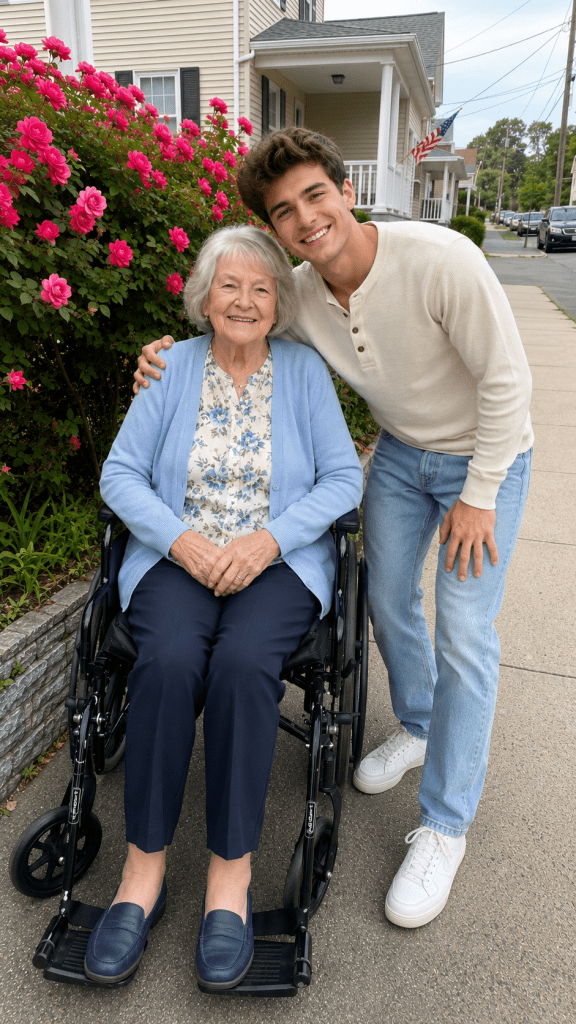

I was barely surviving when my elderly neighbor made me an offer that sounded too unbelievable to refuse: care for her until the end of her life, and she would leave everything she owned to me. I agreed. But when her will was read, I got absolutely nothing. I walked away convinced she had betrayed me—until the next morning, when her lawyer handed me something that changed my life forever.
A Promise That Felt Impossible
I sat quietly inside a lawyer’s office, directly across from Mrs. Rhode’s niece. Every few seconds, she shot me the same look people give dirt stuck beneath their shoes.
The lawyer adjusted his glasses, opened a folder, and began reading in a dull, emotionless voice.
“The property located on Willow Street will be donated to Saint Matthew’s Outreach Charity.”
I frowned.
“What?”
Without looking up, he continued.
“Her personal savings will be divided among Saint Matthew’s Church and several charitable foundations. Her jewelry collection will go to her niece.”
I waited for him to say my name.
Mrs. Rhode had promised me that if I cared for her during the last years of her life, everything she had would become mine.
The lawyer flipped one final page and shut the folder.
“That concludes the reading.”
I stared at him in disbelief.
“That’s all? But she told me—”
Then the truth hit me like a punch to the stomach.
Had Mrs. Rhode lied to me the entire time?
I stood so quickly my chair scraped across the floor, then hurried out before anyone could see the tears building in my eyes.
By the time I reached my tiny rental house, my chest felt tight.
I shut the door, dropped onto my bed without removing my boots, and stared at the ceiling.
At first I was furious.
Then embarrassed.
Then came that awful feeling I knew too well—the feeling of being the fool everyone else had already figured out.
But underneath all of it was something even heavier.
Grief.
Because somewhere along the way, I had started believing I mattered to Mrs. Rhode just as much as she mattered to me.
Growing Up Without Trust
Maybe I should have expected disappointment.
I grew up in foster care.
My mother abandoned me after I was born, and my father spent most of his life behind bars.
I learned early that adults could promise you the world and still walk away without guilt.
I learned how to pack my belongings fast, keep my important things together, and never cry in front of strangers if I could avoid it.
When I finally aged out of the system, I owned little more than two garbage bags full of clothes and no real future.
I ended up in town because the rent was cheap and nobody cared enough to ask questions.
I bounced between awful jobs and terrible bosses just to survive.
Then I found work at Joe’s Diner.
Oddly enough, I liked it immediately.
Joe hired me during a breakfast rush after one of his waitresses quit mid-shift.
He looked at me and asked,
“You ever carry three plates at once?”
I answered honestly.
“No.”
He shrugged.
“You’ve got ten minutes to figure it out.”
That was Joe—rough around the edges, built like a truck, always grumbling, but still kinder than most people I’d met.
After long shifts, he’d shove a plate of fries and a burger toward me.
“Eat before you pass out and create paperwork for me.”
After closing time, I’d stay behind helping wipe down counters while Joe complained about suppliers, broken freezers, rising costs, and customers who ordered eggs “medium-medium-well.”
And every Tuesday and Thursday morning at exactly eight o’clock, Mrs. Rhode walked through the diner doors.
Mrs. Rhode
The first time I served her, she squinted at my nametag.
“James,” she said. “You look exhausted enough to fall face-first into my waffle.”
“Long week,” I answered.
She snorted.
“Try being eighty-five.”
That was how we met.
After that, she always requested my section.
One morning she asked,
“You ever smile, boy?”
“Sometimes.”
“I doubt it.”
Another time she looked me over and said,
“Your hair somehow looks worse every time I see you.”
“Good morning to you too.”
“Hm. Better. You almost sound alive today.”
She was difficult in a strangely lovable way.
She never acted warm or sentimental, but she paid attention to people, and that meant more than most kindness ever could.
One afternoon, while I was carrying groceries home, she called to me from behind her fence.
“You live nearby, James?”
“Just a couple houses down.”
She studied me carefully.
“You want to earn some decent money?”
I hesitated.
“Doing what?”
She opened her front door and motioned me inside.
“Come in. I’ll explain over tea.”
The tea tasted like boiled grass, but she got straight to the point.
“I’m dying,” she said casually.
I nearly choked.
“Oh stop reacting like that. I’m eighty-five, not thirteen. The doctor says I may have a few years left, maybe less. I need help. Groceries. Medication. Rides. Small repairs. And I don’t have anyone reliable.”
I looked at her carefully.
“And what do I get in return?”
She held my gaze before answering.
“When I’m gone, everything I own will belong to you.”
I stared at her.
“You barely know me.”
“I know enough.”
The whole arrangement sounded insane.
Maybe it was.
But I desperately needed the money.
And deep down, part of me wanted to believe someone could actually mean what they said.
So I shook her hand.
“Deal.”
The Family I Never Expected
At first, things were simple.
I drove her to appointments, bought groceries, organized medications into little containers, fixed loose cabinet hinges, cleaned gutters, changed lightbulbs, and took out trash.
She complained constantly.
“You’re late.”
“It’s been four minutes.”
“Still late.”
I’d tell her she was impossible.
She’d respond,
“And yet you keep coming back.”
Slowly, things changed between us.
She began asking me to stay for dinner.
Her cooking was terrible, though she took personal offense if I pointed that out.
One evening she made a meatloaf so dry I needed three glasses of water just to swallow it.
“This is awful,” I told her.
She pointed her fork at me.
“Then starve.”
Sometimes we watched game shows together while she shouted answers at contestants through the television.
Eventually she started sharing stories from her younger years.
And somehow, I started sharing things too—foster homes, loneliness, and how I never planned too far ahead because trusting the future felt dangerous.
One night she muted the television and looked at me seriously.
“You only think about surviving the next month, James. Don’t you have dreams?”
I shrugged.
“I guess I’d like to move up at the diner someday.”
“Well,” she replied, “that’s at least something.”
That winter she handed me a pair of ugly green knitted socks.
“I made these,” she muttered. “So your feet don’t freeze.”
At work, Joe eventually noticed how quickly I rushed out after every shift.
“You got yourself a girlfriend?” he asked.
“I’m helping Mrs. Rhode.”
Joe nearly dropped an entire coffee pot laughing.
“That old battle-axe? Helping her with what?”
I explained the arrangement.
When I finished, he nodded thoughtfully.
“Well, that’s strange as hell. But she likes you. That matters.”
I pretended not to care.
But those words stayed with me all day.
Because I didn’t really know what family was supposed to feel like.
Still, I imagined it probably felt a little like what I had with Mrs. Rhode.
The Morning I Lost Her
A little over a year later, I found her.
When she didn’t answer the door, I used the spare key she’d given me.
The television was still playing.
A cup of tea sat cold beside her chair.
And she was there.
Still.
I knew immediately.
I felt it before I even touched her.
But I called her name anyway.
When I touched her hand, it was ice cold.
I called the hospital.
Then I collapsed beside her chair and cried harder than I had in years.
The funeral passed in a blur.
I stood in the back feeling like I had no right to grieve the way I did.
Then came the reading of the will.
The humiliation.
The realization that maybe Mrs. Rhode had lied to me from the very beginning.
Not only about the inheritance—
But about caring about me at all.
What She Really Left Behind
The next morning, loud knocking rattled my front door.
I opened it feeling numb.
Mrs. Rhode’s lawyer stood outside holding an old dented lunchbox.
“What now?” I asked bitterly.
“She left additional instructions,” he said. “For you alone.”
He handed me the box.
“Actually… she left you one final thing.”
Inside was a small envelope with my name written in her shaky handwriting and a plain metal key.
My hands trembled before I even opened the letter.
James,
You are probably angry that I left you nothing, but trust me—what I prepared for you will change your life.
I know you first agreed because of the money, but somewhere between grocery trips, terrible dinners, and bad television, you became the son I found too late in life.
My knees gave out beneath me.
She had cared.
Through tears, I kept reading and realized she had left me something far more valuable than a house or a bank account.
You once told me you wanted to keep working at the diner. So now, part of it belongs to you.
Months ago, I secretly approached Joe and purchased partial ownership for you. He agreed to teach you how to run the business.
The key is for the diner.
Houses fall apart. Money disappears. But I hope this gives you something more important—a reason to dream.
I barely remember standing up.
One moment I was crying on the floor.
The next, I was running toward the diner with that key clenched tightly in my hand.
A Future I Never Imagined
The diner was quiet when I walked in.
Joe stood behind the register refilling sugar dispensers.
I held up the key.
“Is it true?”
Joe slowly set the jar down.
“Yeah.”
Then he pulled a folder from beneath the counter.
Inside were official ownership papers with my name printed across them.
Percentages.
Account records.
Signatures.
Everything real.
Everything legal.
Everything impossible.
I laughed and cried at the same time, which would have embarrassed me any other day.
Joe watched me quietly.
Then his expression softened.
“She was proud of you,” he said softly. “You know that, right?”
I covered my face with one hand, trying not to completely fall apart in the middle of the diner.
After a long silence, Joe cleared his throat.
“All right. Enough crying. We open at five tomorrow morning. Hope you’re ready to learn how to run a diner, partner.”
And something inside me shifted in that moment.
For the first time in my life, I stopped thinking about how to survive the next week.
For the first time ever—
I started thinking about a future.