
Shaken, I walked into the school office expecting anger. My son’s behavior had been called “reckless,” and I was ready to hear every consequence laid out in front of me.
Instead, I stopped in my tracks.
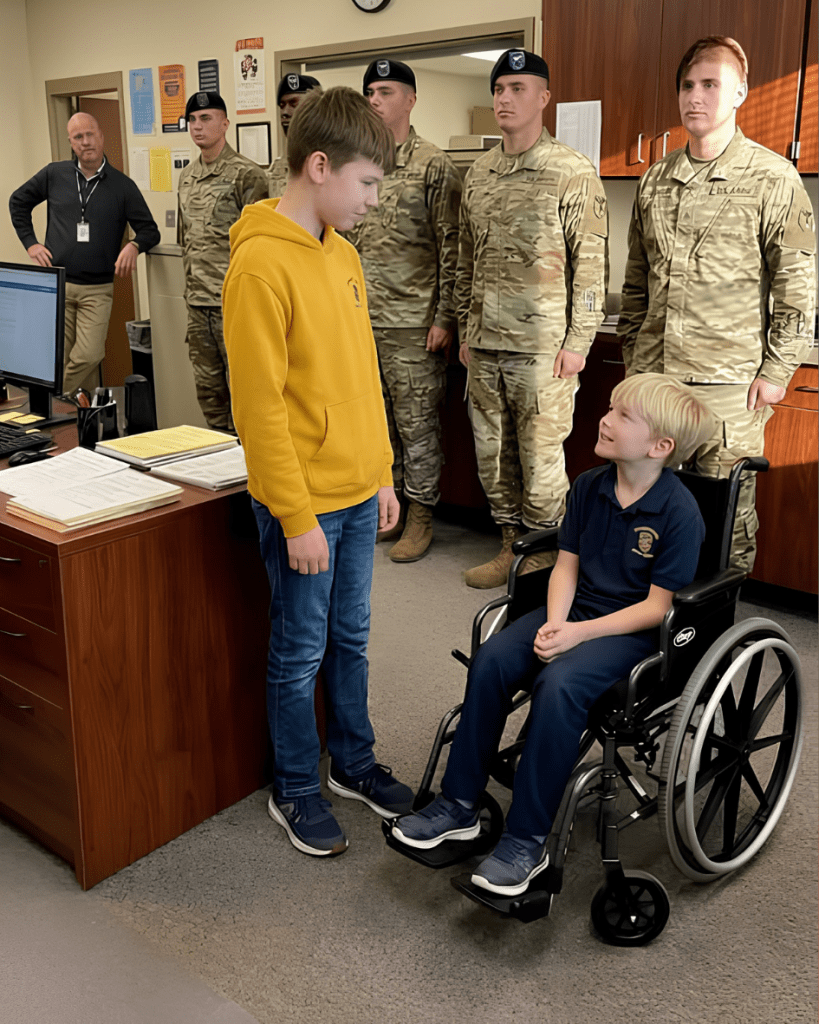
Five men stood in a straight line near the principal’s desk. Crisp military uniforms. Polished boots. Rigid posture. They didn’t belong in a school office—they belonged somewhere far more serious.
The principal looked pale, almost relieved to see me, but also deeply unsettled.
Before I could speak, the door opened again.
Leo walked in.
He looked exhausted, still carrying the faint marks of yesterday’s hike—dust on his shoes, sleeves slightly torn, eyes unsure of what he was walking into. He froze when he saw the soldiers.
The tallest of them stepped forward. His uniform was older, decorated with rows of medals that caught the light.
“We heard about the six-mile trek,” he said quietly. “We heard about the boy you refused to leave behind.”
The room went completely still.
I didn’t understand at first. Then it hit me—these weren’t just officers. They were veterans. Men who had served alongside Leo’s late father.
Men who understood what it meant to carry someone when you had every reason to stop.
Leo shifted uncomfortably under their gaze.
“He’s my best friend,” he said softly, like it was the simplest explanation in the world. “They said he couldn’t go. I just didn’t think that was fair.”
The officer studied him for a long moment, then reached into his pocket.
He pulled out a military patch.
Not just fabric—something heavier than that. A symbol of service, loyalty, and sacrifice.
He stepped forward and pinned it onto Leo’s shirt.
“You carried more than your friend on that trail,” the officer said. “You carried your father’s legacy. And you carried it well.”
My throat tightened.
Behind me, I could hear the teachers who had been so angry yesterday now standing completely silent. No lectures. No discipline. Just stillness.
Because what they had called a violation… these men called honor.
One by one, the officers stepped forward and shook Leo’s hand. Each handshake felt deliberate, like a quiet acknowledgment of something far bigger than a school rule.
Leo just stood there, confused by all of it.
After everything settled, the principal finally spoke—but even his voice had changed.
The anger was gone.
That evening, when we got home, the patch sat on Leo’s desk under the soft light of his lamp. He stared at it for a long time, still not fully understanding why people were so moved by what he had done.
“I just didn’t want to leave him behind,” he said again, almost to himself.
Watching him, I realized something I hadn’t fully understood before.
Character doesn’t announce itself loudly. It doesn’t ask for permission. It simply shows up when someone needs you most.
And my son—without meaning to, without even realizing it—had already become the kind of person the world remembers.